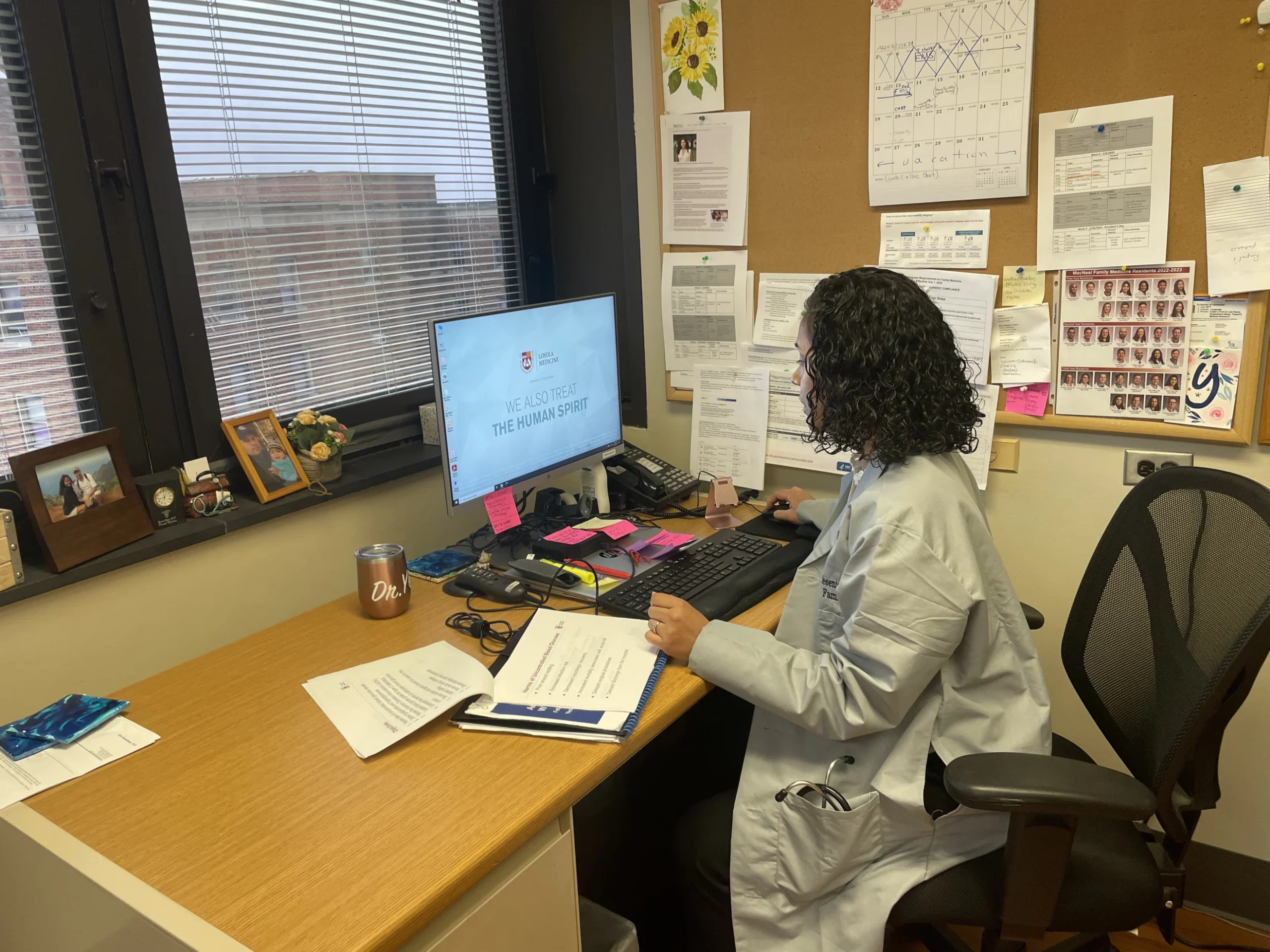

Featuring Dr. Yesenia Yepez, HCF Board Member: An Inspiration to Future Generations, Her Patients, and Our Community
March 2023
Note: This post was originally published in March 2023. Since the publication date, Dr. Yepez transitioned to Associate Program Director and Site Medical Director for the Rush-Esperanza Family Medicine Residency Program based at Esperanza Health Centers.
We recently sat down with Dr. Yesenia Yepez, a physician practicing Family Medicine with Obstetrics at Loyola-MacNeal Hospital and HCF Board member since 2019. She shared her thoughts about the power of female mentorship, why she loves to teach in Loyola-MacNeal’s Family Medicine Residency Program, and how her background and experience as an HCF Board member have informed her view and approach to whole-person care.
What Being a Latina Physician in Our Region Means to Her
“When I care for patients, I see it in their eyes and in the way they interact with me. I carry that with a lot of respect that they would trust me that way. I do recognize that they are giving me a different level of trust than they are giving other providers when they identify with me. That means a lot to me and, of course, it makes it that much more rewarding to get to do what I do.
I’ve always worked in a predominantly Latino community, and getting to be where I know I’m needed is worth it. I have lived in the Healthy Communities Foundation service region for 15 years. It was where I was first introduced to family medicine. My very first clinical rotation as a third-year medical student was with MacNeal Hospital i In 2018, Loyola Medicine acquired MacNeal Hospital and its affiliated operations. The former MacNeal Hospital is now referred to as Loyola-MacNeal Hospital. , which was super memorable. Not being from Chicago, I had no idea where Berwyn was or what was in the community. But I remember leaving the halls of the prestigious University of Chicago in Hyde Park and it being the first time I spoke in Spanish with patients. Patients needed me to speak Spanish when I was rotating there, and that gave me the strength and energy to keep going because I could see the need as well as the appreciation in the patients’ eyes.
Andale, mija. Echale ganas. (Come on, you can do it.)
So yes, I’m going to keep working harder. It’s because those interactions take away how scary some things are going on in their health. Not having to be self-conscious about how you convey what’s going on with your health. Not having to spend so much energy wondering if [the physician] can understand the culture, the language, the ‘how’ you express yourself. Those things really matter, especially in family medicine.”
Motivating Resident Physicians With Her Story
"I love sharing with [residents] i Dr. Yepez teaches both medical students and resident physicians in the Loyola-MacNeal Family Medicine Program. She uses the terms "students" and "residents" interchangeably throughout our following conversation. that my parents immigrated to the United States and that I’m a first-generation college-educated student. [My parents] were blue-collar workers. They sent me to college on salaries that they earned in factories. They were very judicial with how they spent it, and I don’t know how they managed it when they didn’t know the language, didn’t know the culture.
I am a product of a public school system in New York City in a not-very affluent neighborhood. It was a good school, and I loved my teachers, but I didn’t know then the disadvantages were stacked up against me and how unlikely it would be that I would be here talking about [my career]. What I’m always grateful to my parents for is—maybe it was ignorance, or maybe it was boldness—but it never occurred to them that I wouldn’t go to medical school. They came [to this country] for all the opportunities, so of course, I was going to go to medical school.
‘And if you don’t get in here, don’t worry mijita, te mando a México. (I’ll send you to Mexico).’ That was sort of the backup plan. (laughs) Except the backup plan never happened. I would go to my first-choice college, I would go to my first-choice medical school, which is how I ended up in Chicago.
But when I sit here and look back, I’m like, ‘Whoa’ [My parents] didn’t know the language, the chances of all of these things lining up to get to be in resident education, to be one of the teachers now. Had I known how unlikely it would have been to [become a doctor], I would have been probably intimidated by that.”
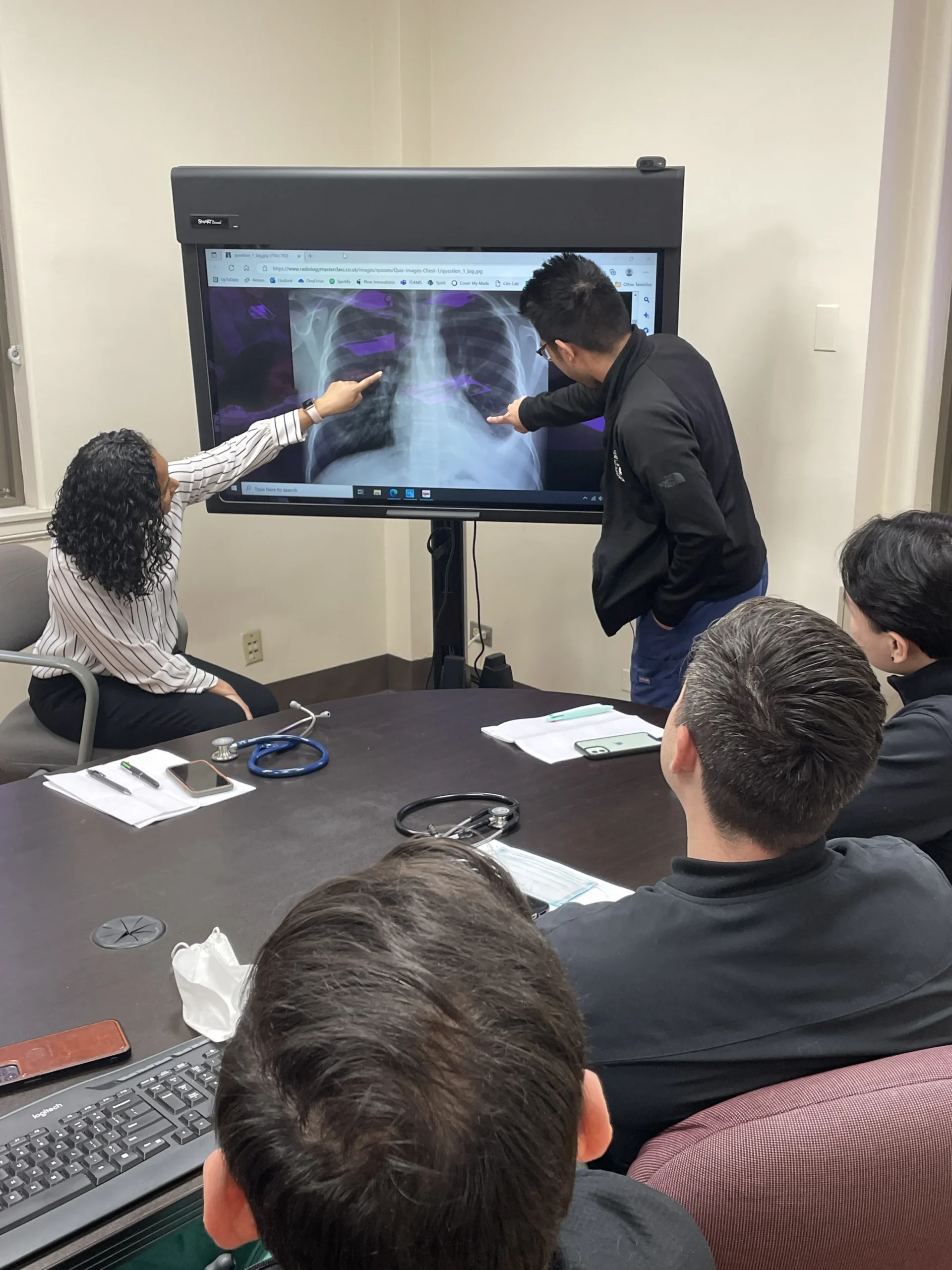
So I love sharing that story with my residents as they’re coming up so they’re not focused on the impossibilities. To just focus on what is, what can be and where a little open door of opportunity can take you.
The Importance of Female Mentorship & Advocacy
“To be honest, it’s no longer scary, day-to-day, to be a woman physician. When I think of the women who mentored me along the way, who gave me opportunities and took a little extra time to help me and give me direction and guidance, that road is full of amazing women who believed in all of us and fought for us. I have countless stories to tell about that.
When I was in medical school and my training, my mentors, I’d say, 80-90% were women. So when I think about Elizabeth Blackwell being the first woman physician—wow. I am standing on so many shoulders where that has become so much easier. I’ve definitely had mentors and women ahead of me who broke other barriers. Some of the harshness and inappropriate treatment from male physicians who were not yet comfortable with women in the field, and what the women who went ahead of me endured, startles me.
I’m so grateful that I didn’t have to encounter it. But I also knew if I had encountered that, I would have gone to them easily and quickly and they would have stood up for me.”
What I do and what it represents to those who went ahead of me and those who are coming up behind me—it’s always a pretty weighty responsibility and, at the same time, I’m just filled with gratitude.
Teaching Future Doctors
One of the reasons why I enjoy being in resident education comes from the interaction with patients and the familiarity and implicit trust that I get. I recognize that there are too few of me to fit that bill. And, while I like to encourage the pipeline of medicine and have more women physicians and more women of color physicians so that it is more likely that the patients look like them, the reality is there’s not enough of us to do that.
“And so if my role is bridging that and translating that for others who have the heart to care for communities of color, that, in the long term, is what gets us closer to the overarching goal. I don’t think we need to look like our patients to give them the kind of honoring and respectful care to have meaningful outcomes.”
Health Happens Outside the Doctor's Office
My heart has been in community health. I started at a federally qualified health center, and it was so intuitive that health started outside of the doctor’s office with the families in their communities. I don’t know if anyone taught me that, but I do think it’s something you have to teach.
“To me, that meant starting a prenatal class, that meant organizing what we used to call the ‘Senior Prom’ where we had all our tercera edad (older adult) patients come in, and we made a prom for them in our lobby. Some of them danced for the first time in a long time, and some of them got up out of wheelchairs. We also had a diabetic class, and we taught them how to make healthy food.
So I always viewed that whatever was happening in the office, one-on-one, was to be bridged with what was happening in the community and how they were living their lives. 99.5% of life happens outside of the doctor-patient relationship, right? We’re a really brief part of that. So you want a patient’s life to be rich, healthy and fulfilling.”
What Being on the HCF Board Means to Her Work
“I moved to MacNeal Hospital full-time around nine years ago, even though I’ve been in the community for longer than that. And I look for opportunities [to learn] about what life in the community is like for my patients as the language has become more and more focused on social determinants of health.
So when Maria (HCF President) came into my office and asked me to be a Board member, I was so overjoyed, so over the moon, to be a part of something outside of my office because that community piece is so important to me.
As a Board member of the Healthy Communities Foundation, I get to be a partner for all the amazing agencies supporting the social determinants of health of the patients I see in the exam room. And when I’m frustrated that we can’t get chronic kidney disease cured and I can’t figure out how to help [my patients] control their diabetes, I get to be a part of supporting all the agencies that are addressing the challenges of rent, their access to mental health, their access to healthy nutrition, and all of the partners that are fighting on behalf of my patients that I get to see day in and day out.
That macro part, knowing what’s supporting our patients’ lives outside of the exam room, helps me keep doing the really challenging work inside the exam room. So I’m just so grateful to be a part of what the Foundation does.”
We’d like to extend a special thank you to Dr. Yepez and Loyola-MacNeal’s Family Medicine resident physicians for welcoming us into their space and allowing us to capture photos and videos during their teaching rounds earlier this month.